

A small business can accept bitcoin without a processor by letting customers pay straight to a wallet you control, with no third party touching the funds. The distinction that matters is custody, not branding: most "no processor" setups still route money through someone else's account. Real processor-free acceptance means your keys, your wallet, and software that only watches for payment.
TL;DR:
- "Without a processor" only counts if the funds never sit in someone else's account; check who holds the keys.
- Three real routes exist: a static wallet address, a self-hosted payment server, or a managed server that never touches your money.
- A static address is free but leaks your balance history and cannot match payments to orders.
- Self-hosted payment software removes the percentage fee, but you pay in uptime, updates, and attention.
- Bitcoin received for goods is taxable income in most countries, so record the fiat value at the moment of receipt.
Table of Contents
- What "Without a Processor" Really Means
- Three Ways to Do It, and Who Each One Suits
- Setting It Up Step by Step
- The Lightning Question
- Who Is Accepting Bitcoin, and What Can People Buy With It
- How Much Is $100 in Bitcoin Right Now?
- Taxes, Records, and Whether the IRS Can See Your Wallet
- Can You Make Money With Bitcoin Without Investing?
- Get Self-Custodial Bitcoin Checkout Without Running a Server
- Frequently Asked Questions
- Sources
What "Without a Processor" Really Means
Most pages ranking for this question quietly redefine it. They list gateways that charge a percentage and call the result "easy." That is a processor, whatever the landing page says.
A processor does three jobs: it generates a payment request, it detects payment, and it holds or forwards the money. Bitcoin lets you do the first two yourself. The third job is the one you can delete entirely, because bitcoin settles to whoever holds the private keys.
So the test is simple. Ask one question of any setup: can anyone other than me move these funds? If yes, a processor is in the loop. If no, you are processor-free, even if software from someone else helps you display a checkout page.
Three Ways to Do It, and Who Each One Suits

Route 1: A static address or QR code
You generate a receiving address in your wallet and put it on a sign, an invoice, or a payment page. Customers send bitcoin; it lands in your wallet.
This works for a market stall, a freelancer with five clients, or a donation link. It breaks down quickly after that. Reusing one address publishes your entire payment history to anyone who looks it up on a block explorer, including your balance and every customer who paid you. It also cannot tell you which order a payment belongs to.
Route 2: Self-hosted payment software
Open-source payment servers generate a fresh address per invoice, watch the blockchain, mark orders paid, and plug into your shop. BTCPay Server is the best-known example, and it is free software with no per-transaction fee. Funds go to your wallet's extended public key, so the server can create addresses but cannot spend anything.
The cost is operational. You need a server, security updates, backups, and a synced node. If your server goes down at 2 a.m., checkout goes down with it. For a technical founder that is a fair trade. For a candle shop owner it is a second job.
Route 3: A managed host for the same software
Here someone else runs the server, and you keep the wallet. The host never holds funds, because the software only holds your public key. You trade a small flat fee for not being a sysadmin. This is the route we would pick for any non-technical seller who wants the self-custody properties of Route 2.
| Route | Per-payment fee | Matches payments to orders | Privacy | Upkeep burden |
|---|---|---|---|---|
| Static address / QR | None (network fee only) | No | Poor: address reuse exposes history | None |
| Self-hosted server | None (network fee only) | Yes | Strong: new address per invoice | High |
| Managed host, your wallet | None (flat monthly fee) | Yes | Strong | Low |
| Traditional processor | Percentage of each sale | Yes | Depends on provider | None |
Setting It Up Step by Step

The sequence is the same for Routes 2 and 3. Skipping the first step is the most common and most expensive mistake.
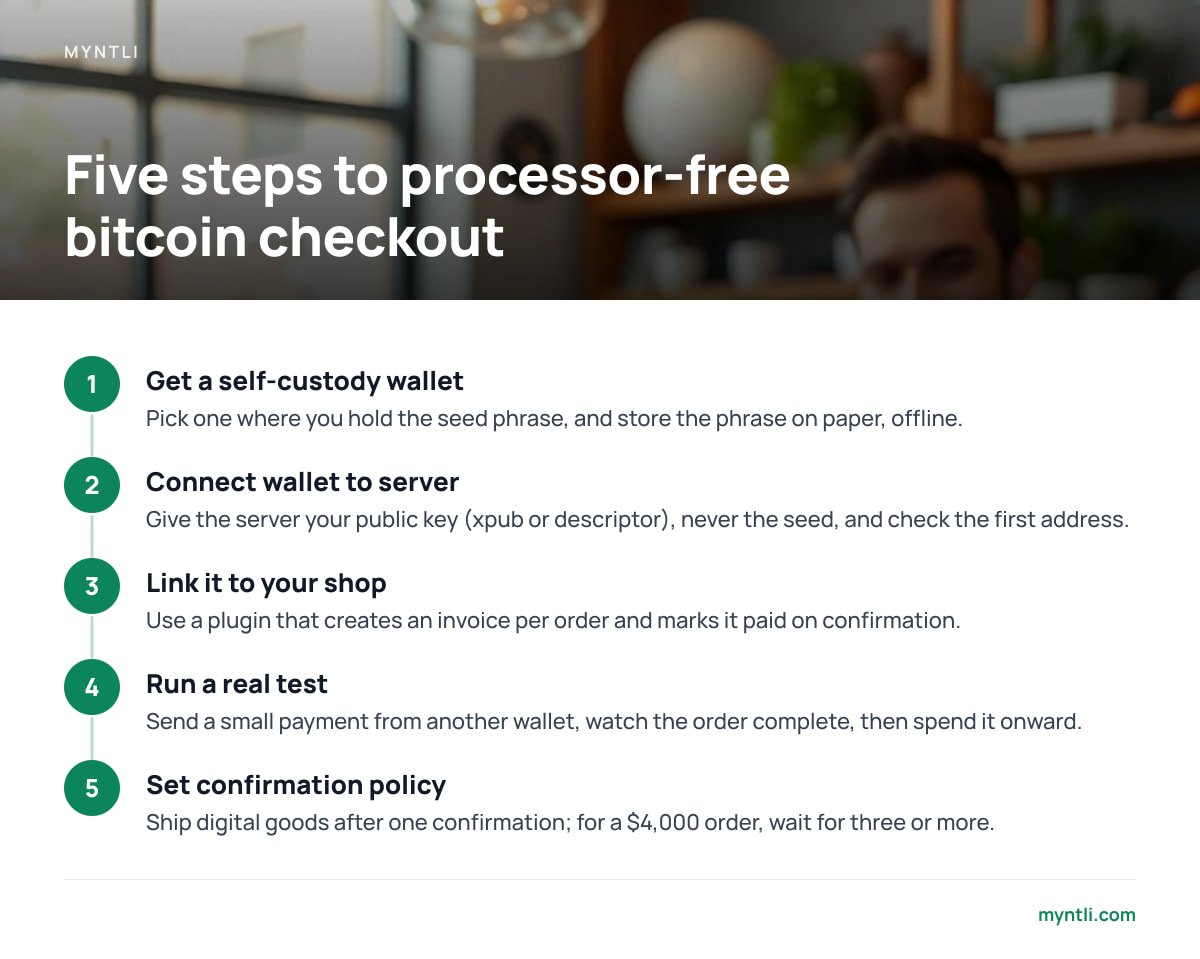
- Get a self-custody wallet first. Pick one where you hold the seed phrase, ideally a hardware wallet if you expect meaningful volume. Write the seed phrase on paper and store it offline. Anyone with that phrase owns your revenue.
- Connect the wallet to the payment server. You give the server your wallet's public key (an xpub or descriptor), never the seed. Confirm the first generated address matches what your wallet shows before you go live.
- Link it to your shop. Plugins exist for the major carts. The plugin creates an invoice per order and flips the order to "paid" on confirmation.
- Run a real test. Send a small payment from a different wallet, watch the order complete, then spend it onward. A test that only goes one direction proves nothing.
- Decide your confirmation policy. For digital goods you might ship after one confirmation. For a $4,000 order, wait for three or more.
If you want the longer walkthrough for a storefront specifically, our guide on how to accept bitcoin in your online store without a middleman covers the plugin side in detail.
A bitcoin payment is final once confirmed. There is no chargeback, so your refund policy is the only dispute mechanism you have.
The Lightning Question
On-chain bitcoin is fine for larger tickets, but it is slow and the network fee does not shrink when the sale does. For small purchases, the Lightning Network settles in seconds at a fraction of a cent.
The catch for a processor-free merchant is liquidity. To receive on Lightning you need a channel with inbound capacity, and a self-managed node needs attention to stay online. A static on-chain address has no such requirement, which is why many small sellers start on-chain and add Lightning later.
Pro Tip: Price in dollars, not bitcoin, and let the invoice lock the exchange rate for 15 minutes. If you list prices in BTC, a 6% overnight swing silently becomes a pay cut or a discount, and you will not notice until you reconcile.
Who Is Accepting Bitcoin, and What Can People Buy With It

Customers often ask this before they pay, so it is worth knowing the landscape. Acceptance is real but patchy. The reliable cases are online: web hosting, VPN and software subscriptions, digital goods, domain registration, and independent creators and stores running their own checkout. Large retailers mostly route crypto through third-party gift-card or payment partners rather than taking it natively, and those arrangements change often, so check a merchant's current checkout rather than trusting an old list.
For a small seller, the practical takeaway is that "We accept Bitcoin" on your site is a differentiator, not a norm. Clothing, coffee, and consulting all work fine, because the product matters less than whether you display a working payment option. If you also pay contractors, the same wallet logic applies in reverse; see our take on a payroll alternative that takes bitcoin direct.
How Much Is $100 in Bitcoin Right Now?
Nobody can answer that in a static article, and any page that does is guessing. The figure is simply $100 divided by the live BTC/USD price. At a price of $100,000 per bitcoin, $100 is 0.001 BTC, or 100,000 satoshis.
For your own checkout, you never do this math by hand. Your payment server pulls a live rate, shows the customer an exact amount, and holds that quote for a short window. What matters for you is which rate source it uses and how long the quote lasts, because those two settings decide whether you absorb price drift.
Taxes, Records, and Whether the IRS Can See Your Wallet
Here is the case where the obvious answer is wrong. Many owners assume "no processor" means "no paper trail." It does not.
The IRS treats bitcoin as property, not currency, and its digital asset guidance says income paid in digital assets is taxable at its fair market value on the date you receive it. Selling goods for bitcoin is therefore ordinary business income, and later selling or spending that bitcoin can trigger a separate capital gain or loss. Other jurisdictions follow a similar split; the OECD's Crypto-Asset Reporting Framework is pushing exchanges toward automatic reporting worldwide.
Can the IRS see your wallet? Not by default. A self-custody wallet is not a registered account, and the blockchain shows addresses, not names. But the link appears the moment you touch a regulated exchange. When you cash out to a bank, that exchange holds your identity and increasingly reports to tax authorities, and investigators can then trace backward through the public ledger. Treat your wallet as pseudonymous, not invisible.
The practical habit that saves you: log every invoice with the fiat value at the time of payment. A good payment server exports this automatically.
Can You Make Money With Bitcoin Without Investing?
Honestly, not much, and be skeptical of anything promising otherwise. Accepting bitcoin as a seller is the legitimate version of this idea: you earn revenue from goods or services, and bitcoin is just the payment rail. Giveaway apps, "free bitcoin" faucets, and mining apps for your phone pay amounts too small to matter, and many are built to harvest your data or upsell you.
The honest framing is that bitcoin does not create income for you. Your product does. Accepting it can widen your customer pool and cut fees, which is where the real gain sits. The cost question is covered in our breakdown of what a payment module is and what it costs.
Get Self-Custodial Bitcoin Checkout Without Running a Server
If the section on Route 2 made you wince, that is the gap Myntli fills. We run the BTCPay Server for you, handle monitoring, updates, and sync, and wire it into WooCommerce, Shopify, Ghost, Magento, PrestaShop, Drupal Commerce, Invoice Ninja, or ReplaPay. A hosted store costs $29 a month flat. Customers pay straight into your own wallet, we take no percentage, and we never hold your funds.
If you would rather own the hardware, we install a full node on your own server for a one-time $449. One honest limit: we can only help you receive payments, so you still need to secure your own seed phrase, and the hosted option means your store depends on our node being up. If you want your own infrastructure outright, our full node explainer lays out the trade-offs, and our guide to a non-custodial gateway shows how to verify any vendor's claims, including ours.
Frequently Asked Questions
Can a small business accept bitcoin without any payment processor at all?
Yes. You can receive bitcoin to a wallet whose keys only you control, using a static address or self-hosted payment software that only watches the blockchain. The key test is that no third party can move your funds.
Do I owe tax if a customer pays me in bitcoin?
In most countries, yes. The IRS treats bitcoin as property and taxes goods or services paid for in it at fair market value on the day received. Spending or selling it later can create a second taxable gain or loss.
What happens if the bitcoin price drops before I sell what I received?
You carry that risk unless you convert promptly. Pricing in dollars and locking the exchange rate on each invoice protects the sale price, but any bitcoin you keep afterward moves with the market.
Is a static QR code safe enough for a real business?
It is safe for the funds but poor for privacy and bookkeeping. Reusing one address exposes your full payment history and cannot match payments to orders. It suits very low volume only.
Can customers get refunds on bitcoin payments?
Only if you send them. Confirmed bitcoin payments cannot be reversed by the buyer, so publish a refund policy and issue refunds manually from your wallet.
Sources
- Digital assets | Internal Revenue Service
- Crypto-Asset Reporting Framework and amendments to the Common Reporting Standard | OECD
- BTCPay Server documentation | BTCPay Server Project
- Bitcoin: A Peer-to-Peer Electronic Cash System | bitcoin.org