

To set up a bitcoin wallet for my business, you generate a private key on hardware you control, back up the seed phrase in two separate places, and import only the public key (the xpub) into your shop so it can watch for payments without holding spending authority. Custody is the decision that matters: a custodial wallet is an account someone else can freeze, while a self-custodial wallet is property your company owns outright and nobody can reverse. For customer receipts, self-custody is the right default, and the cost is that lost keys are lost funds.
TL;DR:
- Custody is the one decision that matters. Everything else is configuration.
- An LLC can hold bitcoin as property, but it needs a resolution, an EIN, and a wallet separate from any personal one.
- Import the xpub into your store, never the seed. The server should be able to watch, not spend.
- Self-custody wallets generate no 1099-DA, so your own records become the tax trail.
- Test with a small payment before you publish the checkout, and raise your recovery wallet's gap limit.
Table of Contents
- The Decision That Comes First: Who Holds the Keys
- Can an LLC Have a Crypto Wallet? Yes, With Three Documents
- How to Set Up a Bitcoin Wallet for My Business, Step by Step
- Can I Create My Own Bitcoin Wallet? What You Actually Control
- Which Crypto Wallet Is Best for Businesses? Match the Wallet to the Job
- Can the IRS See Your Crypto Wallet? Reported, Unreported, and Traceable
- Free, Online, and "Without KYC": Where the Shortcuts Break
- Wiring the Wallet Into Your Shop Without Handing Over Custody
- Get a Self-Custodial Bitcoin Checkout Without Running a Server
- Frequently Asked Questions
- Sources
The Decision That Comes First: Who Holds the Keys
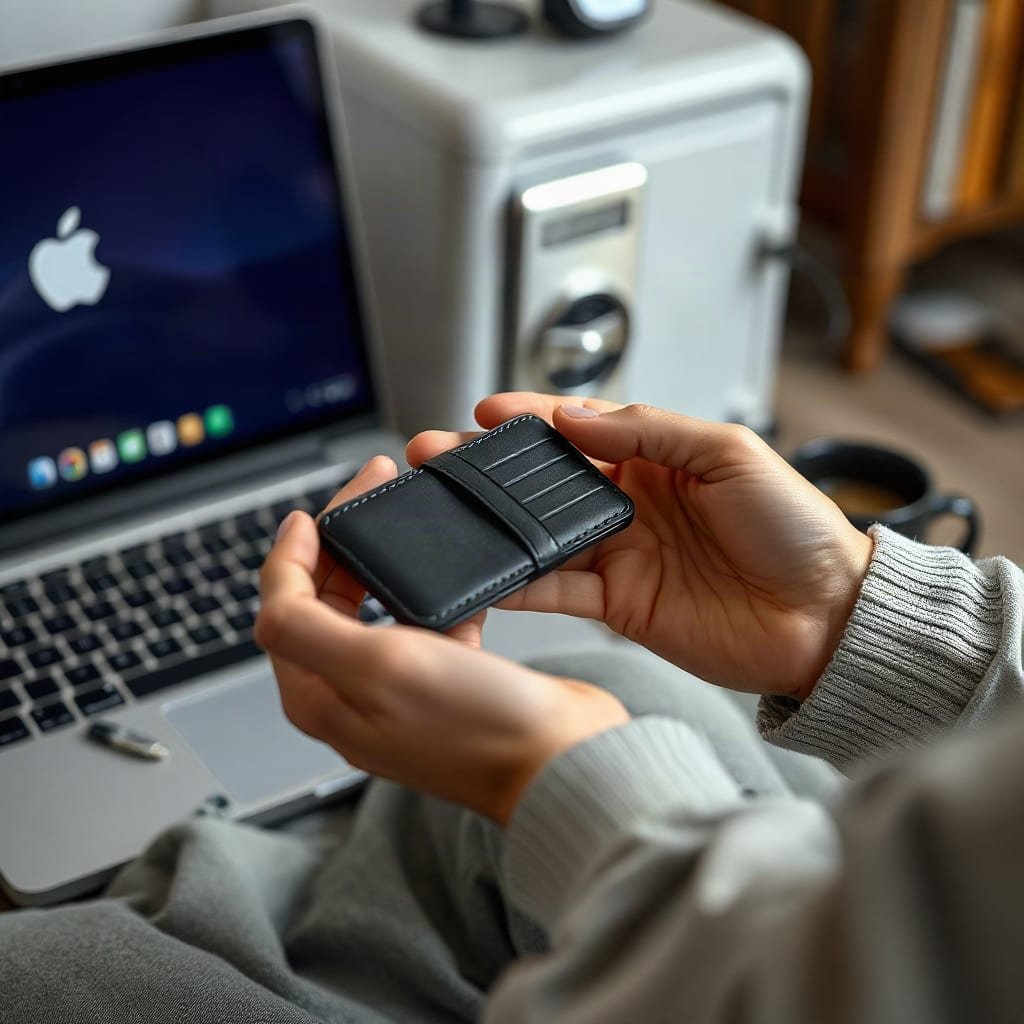
A bitcoin wallet is a key manager, not an account. Whoever can read the private key can move the coins, and that fact decides how you set one up for a company.
Custodial means a provider holds the keys and you log in. Self-custodial means the keys live on hardware you control, and any software in between only watches the chain.
| Custodial wallet | Self-custodial wallet | |
|---|---|---|
| Who can move funds | The provider, on your instruction | You, with the seed or hardware device |
| Recovery | Provider resets your password | Your backup, or nothing |
| Onboarding | Business documents, KYC review | None at the wallet level |
| Failure mode | Freeze, insolvency, account closure | Lost backup, wrong address, no undo |
| Sensible use | A small operating float | Customer receipts and treasury |
For a business taking customer payments, self-custody is the right default. A frozen custodial account is a cash flow problem you cannot argue your way out of, and freezes during disputes are common in the payments industry. The trade is real: nobody can reverse a mistaken payment, and nobody can restore a lost seed.
A 12-word BIP39 seed phrase carries 128 bits of entropy. Anyone who reads those twelve words owns the balance, and no support desk can reverse the transfer.
Can an LLC Have a Crypto Wallet? Yes, With Three Documents
An LLC can hold bitcoin the way it holds a truck or a brokerage account: as property titled to the entity. Nothing in US federal law prohibits it, and the IRS treats cryptocurrency as property, which is the framing your accountant will use at year end.
Three things make the wallet the company's and not yours:
- A resolution or operating agreement clause. One paragraph authorizing the entity to hold digital assets and naming who may sign transactions. Without it, a dispute over ownership comes down to whose device it was on.
- An EIN and a business bank account. The wallet address should appear in your books next to the bank account, funded and reconciled the same way.
- A signer policy. For balances above a few thousand dollars, use a 2-of-3 multisig so no single person or stolen device can move funds.
Keep the business wallet separate from any personal wallet you own. Commingling is the fastest way to lose both the property argument and the clean audit trail.
How to Set Up a Bitcoin Wallet for My Business, Step by Step
- Decide the job before you buy anything. A wallet that receives customer payments and a wallet that holds treasury reserves are different tools with different risk profiles. Most businesses need both.
- Buy two hardware signers, not one. The second device is how you verify that your backup restores. A backup you have never tested is a hope.
- Generate the seed offline. Air-gapped, on the device, with no camera and no network in the room. Write the words by hand.
- Store the backup twice, in two places. Two copies in the same building survive a burglary and fail a fire. Metal plates survive both.
- Add a passphrase if the balance justifies it. A BIP39 passphrase creates a second wallet from the same seed. Store it physically apart from the seed words, because together they are one key.
- Verify the receive address on the device screen. Malware that swaps a clipboard address is common and cheap. The device display is the only trustworthy source.
- Send a test amount. Twenty dollars, confirmed end to end, before the store goes live.
- Export the xpub, not the seed. The extended public key lets your shop derive addresses and watch for payments with no spending authority.
- Record the fingerprint and derivation path. Write down the master fingerprint and the account path (usually
m/84'/0'/0'for native SegWit). You need both to restore, and guessing wastes hours.
Pro Tip: The gap limit is the trap most merchants hit. Wallets derive addresses in sequence and most stop scanning after 20 unused ones. If your shop issues a fresh address per invoice and you later restore from seed, a wallet with a 20-address gap limit can show a zero balance while your coins sit on address 47. Raise the gap limit in your recovery wallet before you conclude that funds are gone.
Can I Create My Own Bitcoin Wallet? What You Actually Control
You cannot create a bitcoin, and you cannot open an account on the network. You generate a private key, and software derives a public key and an endless chain of addresses from it. That is all creation involves, and it takes about four minutes offline.
The address format you choose affects what you pay in fees:
| Prefix | Format | Notes |
|---|---|---|
1... |
Legacy P2PKH | Highest fees, oldest support |
3... |
Wrapped SegWit (P2SH) | Broad compatibility, mid fees |
bc1q... |
Native SegWit (bech32) | Lower fees, the right default for invoices |
bc1p... |
Taproot (bech32m) | Cheapest on some spends, thinner support |
To create a Bitcoin wallet address, you take the xpub, pick the next unused index, and encode it. Your shop does this for every order. Never reuse one address across customers: it links their payments to each other on a public ledger, permanently, and makes reconciliation harder.
Bitcoin.org's wallet chooser is a reasonable starting filter for form factor, though it sorts by platform rather than by business need.
Which Crypto Wallet Is Best for Businesses? Match the Wallet to the Job
No single wallet is best, because a functioning business needs at least three.
| Job | What it needs | What to use |
|---|---|---|
| Customer receipts | Watch-only, no keys on the server | xpub imported into your store or payment node |
| Treasury | Offline keys, multiple approvers | 2-of-3 multisig with devices in separate locations |
| Daily float | Small balance, fast access | Phone wallet holding a week of expenses at most |
| Lightning | Channels and inbound liquidity | A node kept separate from treasury funds |
The working rule: the wallet that touches the internet never holds more than you could lose in a week without changing any plans. Everything above that sits on a device that has never been online.
Can the IRS See Your Crypto Wallet? Reported, Unreported, and Traceable
That one question holds three.
What is reported. Brokers began filing Form 1099-DA with the IRS for the 2025 tax year, covering digital asset sales. The IRS digital assets guidance confirms the treatment that has applied since 2014: cryptocurrency is property, so every disposal is a capital event. Form 1040 also asks a direct digital asset question near the top of page one.
What is not reported. A self-custody wallet generates no form at all. Receiving bitcoin from a customer is not a taxable event in itself. The gain or loss happens when you spend or sell the coins, and you need the dollar value at the moment of receipt to compute it.
What is traceable. The blockchain is public and permanent. Analytics firms cluster addresses and follow flows, so a payment to your store is visible to anyone who knows the address, including the balance sitting behind the same xpub.
A self-custody wallet produces no 1099-DA. The chain is public, the reporting is not, and the record-keeping obligation lands on you.
In practice, keep a monthly export: every receipt, its dollar value at the time, and the address it arrived on. Specific identification of which coins you sold beats a default FIFO assumption when you file.
Free, Online, and "Without KYC": Where the Shortcuts Break
Free is normal. Open-source wallets cost nothing, and the real cost is the hour you spend testing the backup. A paid wallet is not automatically safer.
Online wallets move the risk. A web wallet that holds keys on your behalf is custodial with a nicer interface. In the EU, custodial wallet providers are crypto-asset service providers under MiCA and need authorization to operate. Elsewhere, check who regulates the provider before you park a balance there.
"Without KYC" applies to the wallet, not the on-ramp. FinCEN's 2019 guidance states that a merchant accepting convertible virtual currency as payment for goods and services is not a money transmitter. That exemption lets you take bitcoin directly into your own wallet. It does not exempt you from income tax, sales tax, or bookkeeping.
The travel rule stops at your door. The FATF standard requires originator and beneficiary information on transfers between regulated virtual asset service providers above USD/EUR 1,000. A customer paying your store directly is not one of those transfers.
Wiring the Wallet Into Your Shop Without Handing Over Custody
The xpub is the bridge. Paste it into your payment node or plugin, and the software derives a fresh address per invoice, watches for the payment, and marks the order paid. The seed never touches the server, so a compromised shop cannot drain the treasury.
Set a confirmation policy that matches your order sizes. Zero-confirmation Lightning is fine under about $50, one on-chain confirmation covers most retail orders, and three confirmations is a sensible floor above $1,000. Publish the policy so customers know why a large order sits pending for twenty minutes.
Reconciliation is where most merchants lose an afternoon. Export a CSV per month with the address, amount, and dollar value, and match it against your order list. For more, read what you actually need to accept bitcoin without a processor and how to tell a real non-custodial gateway from a marketing claim. The custodial versus non-custodial processor comparison covers the fee structures side by side.
Get a Self-Custodial Bitcoin Checkout Without Running a Server
Everything above has one cost that never appears in a wallet comparison: somebody has to keep the node synced, patched, and online, and that somebody is usually you at 11pm. Myntli runs a BTCPay Server node and wires it into your existing shop for $29 a month. Payments land in the wallet you control, because you import your own xpub. Myntli never holds a key, takes no percentage of the sale, and does not KYC your customers. If you would rather own the hardware, a full node installed on your own server is $449 one time. Integrations cover WooCommerce, Shopify, Ghost, Magento, PrestaShop, Drupal Commerce, Invoice Ninja, and ReplaPay, with API access for anything custom.
The limit: this is infrastructure, not a custodian. If you lose your seed phrase, Myntli cannot recover your funds, and no support ticket will change that. Check the spec sheet before you commit, including ours. Confirm which derivation path your store uses, and run a small live payment before you announce the checkout to customers. If you do not yet have a self-custody wallet, ask for setup guidance before the install, not after.
Frequently Asked Questions
Can an LLC have a crypto wallet?
Yes. An LLC can hold bitcoin as property titled to the entity, the same way it holds a brokerage account. Put a resolution or operating agreement clause in place, use the company EIN, and keep the wallet separate from any personal wallet so the ownership and the audit trail both hold up.
Can I create my own bitcoin wallet?
You generate a private key on a device you control, and software derives the public key and address chain from it. You are not creating anything on the bitcoin network itself, and no permission is required. The process takes a few minutes offline, and the backup decides whether the wallet survives.
Can the IRS see your crypto wallet?
The IRS receives Form 1099-DA from brokers for digital asset sales starting with the 2025 tax year, and Form 1040 asks a direct digital asset question. A self-custody wallet generates no form, but the blockchain is public and analytics firms trace flows. Your own records of dollar value at receipt make the filing defensible.
Which crypto wallet is best for businesses?
No single wallet covers every job. Use a watch-only xpub setup for customer receipts, a 2-of-3 multisig hardware arrangement for treasury, and a phone wallet with a small balance for daily spending. The wallet connected to the internet should never hold more than a week of operating expenses.
How much does it cost to set up a bitcoin wallet for a business?
Software wallets are free and open source. Two hardware signers run roughly $100 to $400 total depending on model, and a metal backup plate is another $30 to $80. Managed payment infrastructure is a separate line item, typically a flat monthly fee rather than a percentage of sales.
Do I need to KYC my customers to accept bitcoin?
No. FinCEN's 2019 guidance says a merchant accepting convertible virtual currency for goods and services is not a money transmitter, so the customer paying your store directly is not a regulated transfer. You still owe income tax and any applicable sales tax on the sale.
Sources
- Digital Assets | IRS
- FinCEN | Financial Crimes Enforcement Network
- BIP 39: Mnemonic code for generating deterministic keys | Bitcoin BIPs
- Choose your wallet | Bitcoin.org
- FATF Recommendations | FATF