

If a custodial crypto processor goes bankrupt, the bitcoin it holds for you stops being yours to withdraw and becomes a claim in its bankruptcy case. Your custodial crypto processor bankruptcy risk equals whatever balance sat on its books on the filing day, so how often you get paid out matters more than how trustworthy the brand looks. Payments already sent to your own wallet are untouched.
TL;DR:
- Your exposure is the balance the processor holds on the filing day, so a weekly payout on $2,000 of daily sales can put up to $14,000 at risk.
- You become an unsecured creditor, often paid years later and sometimes in dollars valued on the filing date. Mt. Gox creditors waited about a decade.
- Withdrawals made in the 90 days before a filing can be challenged by the trustee under 11 U.S.C. § 547, so a last-minute exit is not guaranteed to hold.
- Whether the coins belong to you or to the estate depends on the processor's terms of service. Read them before you need them.
- A non-custodial setup removes the balance risk but not the downtime risk, so keep your wallet seed backed up and know how to repoint your checkout.
Table of Contents
- What Happens to Your Bitcoin Payments the Day a Custodial Processor Files
- Custodial Crypto Processor Bankruptcy Risk, Measured in Days of Sales
- Why Your Bitcoin Turns Into a Dollar Claim, and Why It Takes Years
- The 90-Day Look-Back: Why Pulling Funds Out Early Can Backfire
- What To Do in the First 48 Hours After Withdrawals Freeze
- Where Non-Custodial Checkout Still Breaks, and What Survives Intact
- How To Shrink Your Exposure Before Any Processor Wobbles
- Get a Bitcoin Checkout That Has No Balance To Lose
- Frequently Asked Questions
- Sources
What Happens to Your Bitcoin Payments the Day a Custodial Processor Files
A bankruptcy filing triggers an automatic stay, which, as the U.S. Courts explain, halts creditors' efforts to collect what they are owed. For you, that means the balance in your processor dashboard is no longer something you can request. It is something you can claim. Whether it is also your property is a separate legal fight, decided mostly by what the processor's terms of service said about ownership.
If you are still choosing between models, the custodial vs non-custodial comparison covers the mechanics. This article covers only the failure case. Here is what you see in the first days:
- Withdrawals stop. Many processors pause them days or weeks before a filing, so the freeze is often the first signal you get.
- Checkout breaks. Invoices created through the processor's API stop settling or stop being created at all.
- Your balance becomes a claim. You join the line of unsecured creditors. Secured lenders and administrative costs usually get paid first.
- Refunds hang. If a customer wants money back and the funds are trapped, you pay it from your own pocket or leave them waiting.
Bitcoin your customers already paid into your own wallet is not part of any of this. It was never on the processor's books.
Custodial Crypto Processor Bankruptcy Risk, Measured in Days of Sales
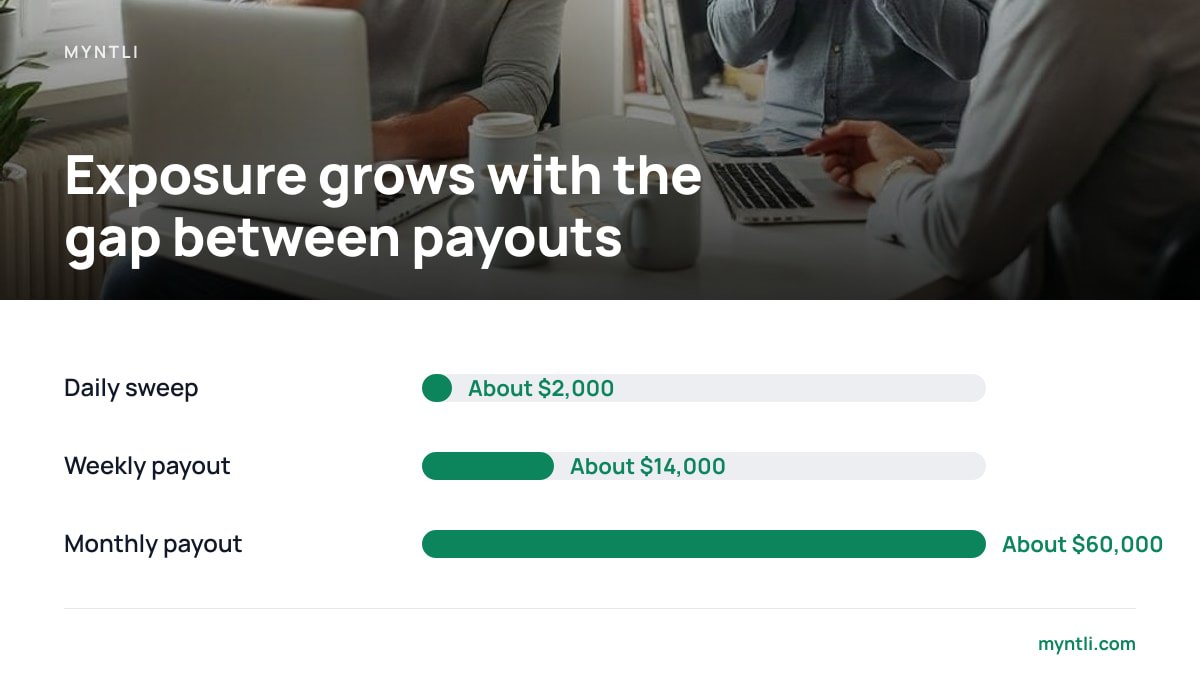
Size the risk in days of revenue, not by the company's reputation. A custodial processor receives the customer's payment first and passes it to you later. Everything between those two moments is an unsecured loan to the processor that you did not know you were making.
| Payout schedule | Daily sales | Most you can have exposed at once |
|---|---|---|
| Daily sweep | $2,000 | About $2,000 |
| Weekly payout | $2,000 | About $14,000 |
| Monthly payout | $2,000 | About $60,000 |
| Balance left to "accumulate" | $2,000 | Everything since you last withdrew |
These are worst-case figures for a filing the moment before a payout. They assume steady sales and no fees. Exposure grows linearly with the gap between payouts.
A weekly payout schedule on $2,000 a day in sales puts up to $14,000 of your revenue in a stranger's hands at any moment.
My view: if you must use a custodial processor, daily sweeps to your own wallet are the minimum. A processor that only pays monthly is asking you to extend it a 30-day credit line at zero interest.
Why Your Bitcoin Turns Into a Dollar Claim, and Why It Takes Years
You are unlikely to get coins back on a schedule you control. Three cases show how it tends to go.
Ownership depends on the contract
In January 2023, Judge Martin Glenn of the U.S. Bankruptcy Court for the Southern District of New York ruled that crypto in Celsius "Earn" accounts belonged to the Celsius estate, largely because of what the terms of use said. Celsius was a lender, not a payment processor, but the logic carries over. If the terms let the company pool, lend or use your coins, a court may treat them as the company's property and you as a creditor.
Claims are often frozen at the filing-date price
FTX filed on November 11, 2022, and its reorganization plan valued customer claims at crypto prices on that date, around $17,000 per bitcoin. Later price moves did not reach creditors. A merchant owed one bitcoin was owed roughly $17,000 in claim value, whatever the coin was worth when payouts finally came.
Timelines are measured in years
Mt. Gox filed in Tokyo in February 2014. The trustee's creditor site shows repayments only began in July 2024. That is the slow end of the range, but nothing guarantees a short one.
Do not assume insurance fills the gap. The FDIC says deposit insurance covers deposits at insured banks and does not cover crypto assets, and it does not protect you if a nonbank crypto company fails.
Pro Tip: Before you need it, open your processor's terms of service and search for "title," "commingle," "lend" and "for its own purposes." Language that gives you title to specific coins held in segregated accounts is the best case. Language that says you hold only a contractual right to be paid is the Celsius pattern, and it means you are an unsecured creditor today, whatever the dashboard says.
The 90-Day Look-Back: Why Pulling Funds Out Early Can Backfire
The obvious reaction to a rumor is to withdraw everything immediately. Sometimes that works, but it is not guaranteed to be final.
Under 11 U.S.C. § 547, a bankruptcy trustee can seek to recover certain transfers made in the 90 days before a filing (one year for insiders). A customer or merchant who withdrew during that window can be sued to return the money if the transfer meets the statute's conditions, such as being made on account of an existing debt while the debtor was insolvent. Recent crypto bankruptcies have included such demands.
90 days. That is how far back a trustee can reach under § 547 to challenge payments made before a bankruptcy filing.
A normal-course daily sweep is far easier to defend than a panic withdrawal of a large balance, and small, routine withdrawals are rarely worth a trustee's litigation costs. So leaving money in is no safer. Regular, small payouts beat a late dash, and you should keep records of every one.
What To Do in the First 48 Hours After Withdrawals Freeze

- Stop sending customers through the processor. Switch off its checkout plugin so no new payments land on its books.
- Export everything. Download invoice history, payout history, fee statements and your balance snapshot while the dashboard still loads. You will need them for a claim.
- Do not assume you can withdraw. Try once, document the result, and stop. Repeated attempts do nothing.
- Find the claims process. The court docket or the appointed claims agent will publish a deadline, often called the bar date, for filing a proof of claim. Missing it can forfeit your claim.
- Talk to a bankruptcy attorney before you move money or sign anything. Questions about preference exposure and asset ownership are specific to the case.
- Set up a replacement checkout. Lost sales cost you more over the following weeks than most small balances.
Where Non-Custodial Checkout Still Breaks, and What Survives Intact
Self-custody removes the balance risk but not every risk. With BTCPay Server, which its documentation describes as a self-hosted, open-source payment processor, customers pay straight into a wallet you control, so a host's insolvency does not touch coins that never passed through it.
| What fails | Custodial processor | Non-custodial setup |
|---|---|---|
| Your balance | Becomes a claim in the estate | Stays in your wallet |
| Checkout availability | Stops | Stops until you repoint to another server |
| Refunds | Frozen with the balance | Paid from your own wallet |
| 90-day clawback exposure | Possible on withdrawals | Does not arise, since payments never sat with the host |
| Your recovery path | Court process, years | Restore from your wallet seed |
The remaining risks are yours: a lost seed phrase cannot be recovered, and a host that controls your checkout page could in principle show a customer the wrong address, so test invoices and check that addresses match your wallet. For a fuller accounting of the downsides, see BTCPay Server pros and cons.
How To Shrink Your Exposure Before Any Processor Wobbles
- Sweep daily, at minimum. Set the shortest payout interval the processor allows and a low balance threshold.
- Keep a written record of every payout. If a trustee asks questions later, a clean ledger is your defense.
- Own a wallet you control. If you do not have one, follow the guide to setting up a bitcoin wallet for your business first.
- Pre-plan the exit. Moving off a custodial service is easier on a calm day, and the steps in moving from Coinbase Commerce to self-custody apply to most processors.
- Keep a backup payment path. Even a single static address on your contact page lets you take an order while the main checkout is down.
I would pick non-custodial for any store doing more than a few hundred dollars a month in bitcoin. The setup effort is a one-time cost. A frozen balance has no ceiling.
Get a Bitcoin Checkout That Has No Balance To Lose
Myntli hosts and maintains a BTCPay Server for you, so payments go directly to your own wallet and there is never a processor balance that a court could freeze. The hosted store on our node is $29 a month flat, with no percentage of sales, no custody and no KYC on your store. We install the node, wire it into WooCommerce, Shopify, Ghost, Magento, PrestaShop, Drupal Commerce, Invoice Ninja or ReplaPay, and handle monitoring, updates and sync. If you would rather run your own hardware, we will install a full node on your server for $449.
There is a limit worth knowing. Funds are safe because you hold the keys, but checkout depends on the node staying online. If we ever failed, your coins would remain yours and your store would need to be repointed to another BTCPay server until it was back. We also cannot recover a lost seed phrase, so back it up before you take your first order.
Frequently Asked Questions
Are my bitcoin payments insured if a custodial processor goes bankrupt?
Generally no. The FDIC says deposit insurance covers deposits at insured banks and does not cover crypto assets or the failure of a nonbank crypto company. Check the processor's own terms for any private insurance claims and what they actually cover.
Will I get my actual bitcoin back after a processor files for bankruptcy?
It depends on the case. FTX's plan valued customer claims at November 2022 prices, so creditors were paid against a dollar figure, while Mt. Gox creditors were repaid from the trustee's holdings beginning in 2024. Expect to wait, and expect the outcome to follow the court's treatment of your claim.
How long does it take to get money back from a bankrupt crypto processor?
Mt. Gox filed in February 2014 and repayments began in July 2024, about ten years later. Other cases have moved faster, but you should plan on months at best and years as a realistic possibility.
Can a trustee take back money I withdrew before the processor filed?
Possibly. Under 11 U.S.C. § 547, a trustee can seek to recover certain transfers made in the 90 days before a filing, if the statute's conditions are met. Routine, well-documented payouts are easier to defend than a large panic withdrawal.
Does using a non-custodial setup remove all bankruptcy risk?
It removes the risk to your balance, because customer payments go straight to a wallet you control. It does not remove downtime if the host fails, so know how to point your store at another BTCPay server and keep your seed phrase backed up.
Sources
- Chapter 11 Bankruptcy Basics | United States Courts
- 11 U.S.C. § 547, Preferences | Legal Information Institute, Cornell Law School
- United States Bankruptcy Court, Southern District of New York (In re Celsius Network LLC) | U.S. Bankruptcy Court, SDNY
- Mt. Gox Co., Ltd. rehabilitation trustee | Mt. Gox Trustee
- Federal Deposit Insurance Corporation | FDIC
- BTCPay Server Documentation | BTCPay Server Project