

Is it legal to accept bitcoin payments? In most countries, yes: a small business can take bitcoin for goods and services, and the obligations are tax and record keeping. Accepting bitcoin as payment is widely allowed. Operating a business that exchanges or holds bitcoin for other people is usually licensed. A merchant who only sells products is almost always in the first group.
TL;DR:
- Accepting bitcoin for your own goods and services is legal in the United States, the EU, the UK, Canada, Australia, Japan and most other large economies.
- Taking bitcoin as a seller is treated as a sale, and you are not running an exchange. Licensing duties usually apply to firms that custody or convert funds for others.
- The tax bill is the main burden: you report income at the fair market value when you receive the bitcoin, and any later price change is a separate gain or loss.
- A small group of countries ban or heavily restrict crypto, so check local rules before you list a bitcoin option, especially if you sell across borders.
- Self-custodial payments keep you out of most money-transmission questions, because you never hold anyone else's funds.
Table of Contents
- Is It Legal to Accept Bitcoin Payments in Your Country?
- Accepting Bitcoin vs. Moving Money for Others
- What Counts as Legal in the United States, EU, UK and Elsewhere
- Countries Where It Is Banned or Restricted
- The Tax and Record-Keeping Duties That Come With It
- Can You Pay for Anything With Bitcoin, and Who Accepts It?
- Why Custody Choice Changes Your Legal Exposure
- A Short Legal Checklist Before You Add a Bitcoin Option
- Get Bitcoin Payments Running Without Holding Anyone Else's Money
- Frequently Asked Questions
- Sources
Is It Legal to Accept Bitcoin Payments in Your Country?
For most small businesses the answer is yes. No major economy requires a merchant to get permission before accepting bitcoin for a product or service. The legal question changes when you start handling money on behalf of other people, which is a separate activity from selling your own goods.
Nearly every country falls into one of three groups:
- Allowed with normal tax rules. The United States, the UK, Canada, Australia, Japan, Singapore and the EU member states treat bitcoin as property, an asset or a taxable good. You may take it as payment and report it like any other income.
- Allowed but restricted in some way. Some countries permit holding crypto but bar banks from servicing it, limit its use in retail, or require registration for businesses that touch it.
- Banned or effectively banned. A short list of countries prohibits crypto payments or trading outright, and the list has shifted over the years.
If you are setting up the technical side as well, the walkthrough for an online store is in How to Accept Bitcoin in Your Online Store Without a Middleman. This article covers only the legal position.
Accepting Bitcoin vs. Moving Money for Others
Regulators draw the line by function. Selling a $40 T-shirt and accepting bitcoin for it makes you a merchant. Taking bitcoin from a customer, converting it to dollars and passing it to a third party makes you something closer to a money transmitter.
The Financial Action Task Force sets the international anti-money-laundering standard that most national rules follow. Its guidance on virtual assets applies to "virtual asset service providers," meaning firms that exchange, transfer, safeguard or administer crypto for customers. A shop that only receives payment for its own inventory does not fit that description.
The same split explains why the payment setup matters. A custodial processor holds your funds before settling them, so it carries the licensing burden and you carry its counterparty risk. If your customers pay straight into a wallet you control, no intermediary holds funds. For a closer look at that arrangement, see Accept Bitcoin Directly to Your Wallet: What Actually Works.
Receiving bitcoin for your own goods is a sale. Holding or converting it for someone else is a regulated service.
What Counts as Legal in the United States, EU, UK and Elsewhere
United States
The IRS treats virtual currency as property, a position set out in IRS Notice 2014-21. When a customer pays you in bitcoin, you include its fair market value in dollars at the time of receipt in your gross income. The IRS also asks about digital asset activity on the front of Form 1040.
FinCEN's 2019 guidance (FIN-2019-G001) says users who obtain convertible virtual currency to buy goods or services for themselves are not money transmitters. Merchants who only accept it for their own sales sit outside that category too. Individual states add their own rules. New York's BitLicense is the best known, but it targets virtual currency business activity, not shops that accept payment.
European Union
Bitcoin is legal tender nowhere in the EU, but nothing stops a merchant from accepting it by agreement. The EU's Markets in Crypto-Assets Regulation (MiCA) governs issuers and service providers, not sellers who take crypto for goods. On VAT, the Court of Justice of the EU ruled in the 2015 Hedqvist case that exchanging bitcoin for traditional currency is exempt from VAT. Your sale of goods is still subject to VAT as usual, calculated on the euro value.
United Kingdom
HMRC treats crypto assets as property, not money. A business that accepts bitcoin records the sterling value as trading income and tracks any later gain or loss separately for Capital Gains Tax or Corporation Tax.
Other markets
Canada, Australia and Japan permit merchant acceptance and tax it under existing rules. Australia's tax authority treats bitcoin received for goods as ordinary business income at its Australian dollar value on the day of receipt. Japan requires exchanges to register, but merchants taking payment do not.
Countries Where It Is Banned or Restricted
A few jurisdictions do not allow it. China bans crypto trading and payment activity on the mainland, and its central bank has repeated that position. Several other countries, including Algeria, Bangladesh and Nepal, have been reported to prohibit or sharply restrict crypto use, though enforcement and wording differ. Rules also change, so read your national central bank or finance ministry statement, not a forum post.
Restrictions affect you in two ways. If your business is based in a restricted country, accepting bitcoin may itself be unlawful. If you ship to customers there, your own country's rules still govern the sale, but the buyer may be taking legal risk by paying. A small seller can usually ignore the second point, but should not ignore the first.
| Region | Merchant acceptance | Main obligation |
|---|---|---|
| United States | Legal | Report fair market value as income (IRS Notice 2014-21) |
| European Union | Legal | VAT on the sale; MiCA covers service providers, not shops |
| United Kingdom | Legal | Record sterling value; track gains separately |
| Canada | Legal | Report income at fair market value |
| Australia | Legal | Treat as business income at AUD value on receipt |
| China (mainland) | Prohibited | Crypto payment activity banned |
The Tax and Record-Keeping Duties That Come With It
Tax is where small merchants get caught out. Every bitcoin sale creates two events. The first is income: the dollar value of the bitcoin when you receive it. The second comes later. If you hold the bitcoin and its price rises before you spend or sell it, the increase is a gain you may owe tax on.
Here is a worked example. A customer pays 0.001 BTC for a $60 order when bitcoin is $60,000. You record $60 of revenue. Three months later you convert that 0.001 BTC when bitcoin is $75,000 and receive $75. The extra $15 is a capital gain, not extra sales income.
Keep these records for every payment:
- Timestamp and amount. The exact time and the BTC received, which you can pull from your payment server's invoice history.
- Fair market value. The fiat rate at that moment, from a consistent source you document.
- Order reference. The invoice or order ID that links the payment to a sale.
- Disposal records. When and at what price you later sold or spent the coins.
Pro Tip: Decide on one exchange-rate source on day one and write it down. Tax authorities mostly want a reasonable, consistent method. Switching between rate sources order by order makes your books harder to defend in an audit.
Can You Pay for Anything With Bitcoin, and Who Accepts It?
You can buy a wide range of things with bitcoin, but not everything, and not everywhere. Whether a seller takes it is their choice, not a legal entitlement. Readers often ask about specific cases.
Does Walmart accept Bitcoin? Walmart does not accept bitcoin directly at checkout in the United States. Some third-party gift card and payment apps let shoppers spend crypto to buy gift cards for large retailers, but that is the buyer converting funds, not the retailer accepting bitcoin.
Does Amazon accept Bitcoin? Not directly. The same gift card workaround exists on third-party sites.
Who accepts Bitcoin in the USA? Independent online shops, creators, software and hosting firms, and many small local businesses. Big-box chains are the exception.
Why use Bitcoin instead of cash? For an online seller the case is practical. A bitcoin payment settles to you without a card network, has no chargebacks once confirmed, and can come from a customer anywhere. The trade-off is price volatility and the tax paperwork above. Cash is simpler for a local shop. For a remote sale, bitcoin removes the card fee and the chargeback risk.
What if you put $1,000 into Bitcoin 10 years ago? Bitcoin traded at roughly $200 to $450 through 2015, so $1,000 would have bought several coins, worth many multiples of that today. For a business, coins held for years after being received as payment would trigger a large capital gain on sale or spend, which is why record-keeping from day one matters. Check a live price chart for the current figure, since bitcoin's price moves daily.
Why Custody Choice Changes Your Legal Exposure

Where the money sits decides which rules reach you. A custodial processor takes payment, holds it, and settles it to you later. That arrangement carries licensing duties for the processor and counterparty risk for you. If the processor fails, you may become an unsecured creditor. The risks are covered in Custodial Processor Bankruptcy: What Happens to Your Bitcoin, and the questions to ask before signing up are in Vetting a Custodial Bitcoin Processor: 7 Checks Before You Pay In.
In a self-custodial setup, the customer's payment goes to an address from a wallet you control. Nobody else holds your funds, so you are not transmitting money for anyone. You remain responsible for tax, sales tax or VAT, and sanctions compliance on your own customers. Self-custody does not remove that last duty, so if you sell internationally, know the sanctions rules that apply to your country.
My position: for a small online seller, self-custody is the simplest legal structure. You still have tax duties, but you avoid the licensing questions a custodian has to answer. If you have no wallet yet, the buyer's test in Best Self-Custody Wallet for Merchant Payments: A Buyer's Test is a good place to start.
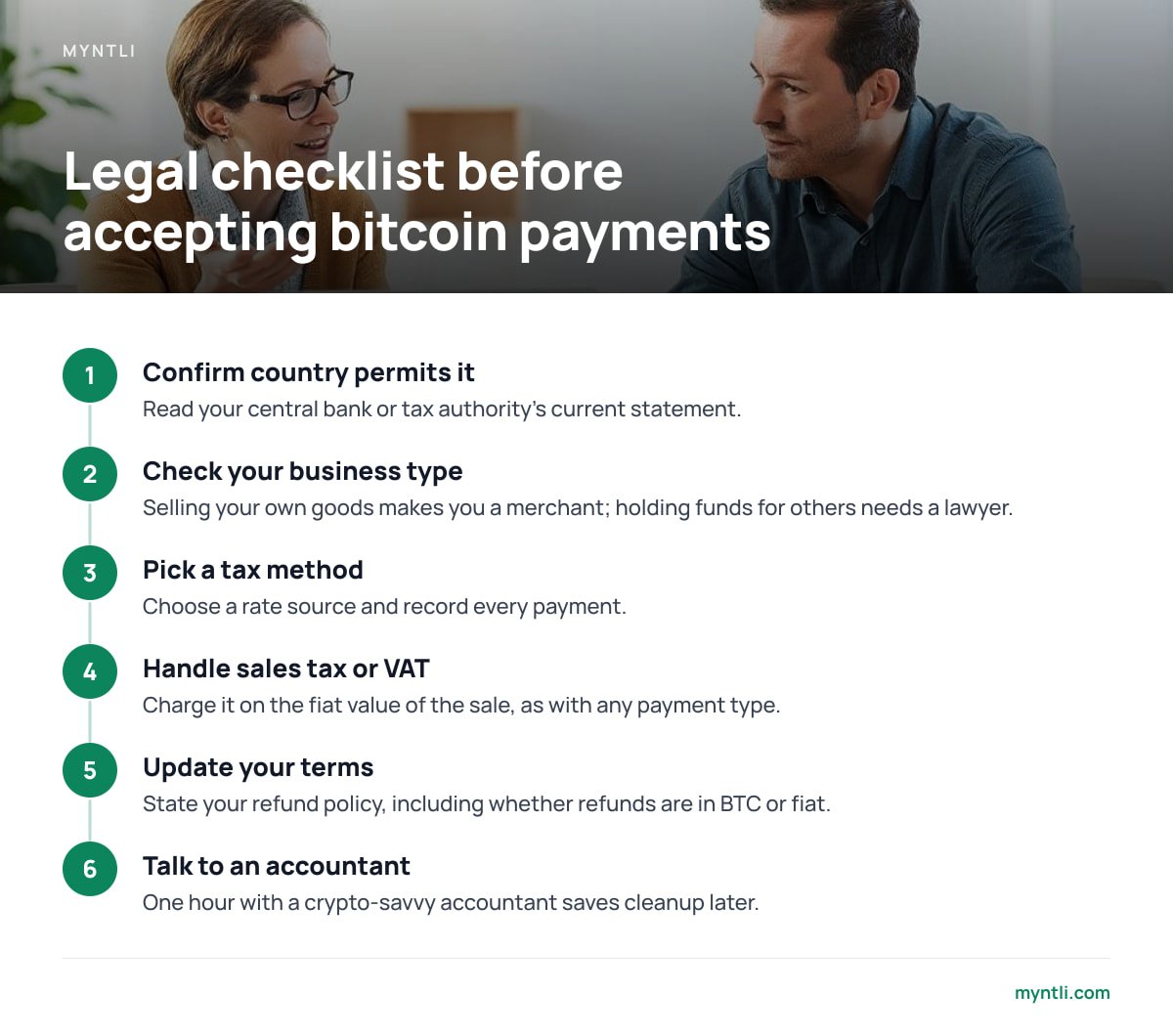
A Short Legal Checklist Before You Add a Bitcoin Option
Work through this in order, and stop at the first "no" until you have sorted it out.
- Confirm your country permits it. Read your central bank or tax authority's current statement.
- Check your business type. If you only sell your own goods or services, you are generally a merchant. If you exchange or hold funds for others, speak to a lawyer.
- Pick a tax method. Choose a rate source and record every payment.
- Handle sales tax or VAT. Charge it on the fiat value of the sale as you would for any payment type.
- Update your terms. State your refund policy in bitcoin terms, including whether refunds are in BTC or fiat.
- Talk to an accountant. One hour with someone who knows crypto saves a lot of cleanup later.
A bitcoin sale creates two taxable moments: the day you receive it, and the day you dispose of it.
Get Bitcoin Payments Running Without Holding Anyone Else's Money
If the legal picture points you toward self-custody, Myntli sets up the payment side. We host a BTCPay Server store on our node for $29 a month, or install a full node on your own server for $449. Customers pay straight to your wallet. We take no percentage, never hold your funds, and need no KYC from you on your own store. We also connect it to WooCommerce, Shopify, Ghost, Magento and several other platforms, and we monitor and update the node so you don't have to.
One caveat: Myntli handles the infrastructure and nothing else. Your tax filings, VAT treatment and local compliance remain your responsibility, so confirm the rules for your country with an accountant before you go live.
Frequently Asked Questions
Is it legal to accept bitcoin payments for my small business?
In most large economies, including the United States, the EU, the UK, Canada and Australia, yes. You report the payment as income at its fair market value in local currency. A few countries ban or restrict crypto, so check your own rules.
Do I need a license to accept bitcoin?
A merchant who only sells their own goods or services generally does not. Licensing usually applies to firms that exchange, transfer or hold crypto for other people. If you plan to do any of those, get legal advice first.
Do I owe tax when a customer pays me in bitcoin?
Yes. You record the fiat value at the time of receipt as business income. If you later sell or spend the bitcoin at a different price, the difference is a separate gain or loss.
Does Walmart accept Bitcoin?
Not directly at checkout in the United States. Shoppers can buy gift cards with crypto through third-party services, but that is a conversion by the buyer, not Walmart accepting bitcoin.
Can a bitcoin payment be reversed?
Not once it is confirmed on the blockchain. That removes card-style chargebacks, but you handle refunds yourself, so state your refund terms clearly before a customer pays.
Sources
- Guidance on Virtual Assets and Virtual Asset Service Providers | Financial Action Task Force
- IRS Notice 2014-21: Virtual Currency Guidance | Internal Revenue Service
- Application of FinCEN's Regulations to Certain Business Models Involving Convertible Virtual Currencies (FIN-2019-G001) | FinCEN