

Reporting bitcoin sales for taxes at year end means listing every sale on Form 8949 with its date, proceeds and cost basis, then totaling the results on Schedule D. If you accepted bitcoin as payment, you also owe US tax on the dollar value of that bitcoin on the day it arrived, so a later sale produces only the gain or loss since receipt. Keep those two events in separate records.
TL;DR:
- Bitcoin is property for US tax purposes. Every sale, swap or purchase made with it is a disposal that produces a gain or loss, and there is no minimum amount below which the IRS stops caring.
- If customers pay you in bitcoin, the dollar value at the moment of receipt is income and also becomes your cost basis for the later sale.
- Buying and holding triggers nothing, and neither does moving coins between your own wallets, but you still need records of both.
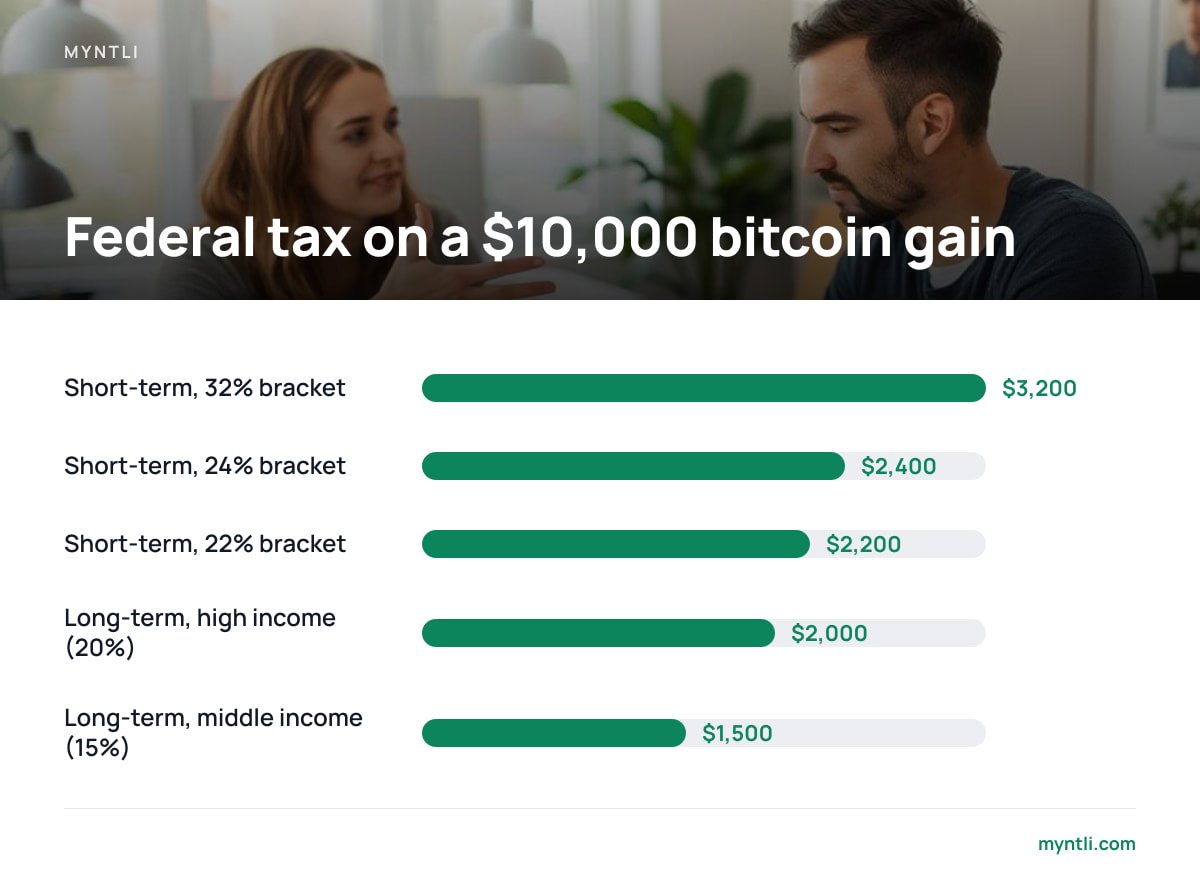
- A $10,000 gain costs anywhere from $0 to roughly $3,200 depending on how long you held and your bracket, so holding period is the cheapest lever you control.
- Exporting your invoice and wallet history monthly is far easier than rebuilding twelve months of rates in April.
Table of Contents
- Receiving and Selling Bitcoin Are Two Separate Taxable Moments
- Do You Have to Report Bitcoin? Yes for Sales, No for Simply Holding
- How Bitcoin Is Valued, and Where Your Cost Basis Comes From
- What $10,000 of Profit Costs You, by Holding Period and Bracket
- Reporting Bitcoin Sales for Taxes at Year End: The Step-by-Step Order
- Pulling Your Records: Self-Custody, Exchanges and Your Crypto.com Tax Information
- ETFs, Stolen Bitcoin and Legitimate Ways to Pay Less
- Outside the US, the Rules Differ but the Reporting Net Is Widening
- Get Clean Invoice Records From a Bitcoin Node You Don't Have to Maintain
- Frequently Asked Questions
- Sources
Receiving and Selling Bitcoin Are Two Separate Taxable Moments
Under IRS guidance on digital assets, bitcoin is property, not currency. If you run a shop that takes it, that means two moments to track. The first is the day a customer pays you. The second is the day you sell, spend or swap what you received.
| Event | Tax treatment | Where it goes |
|---|---|---|
| Customer pays you in bitcoin | Ordinary income at USD fair market value on receipt | Schedule C (business) or Schedule 1 |
| You sell bitcoin for dollars | Capital gain or loss against your basis | Form 8949, then Schedule D |
| You pay a supplier or contractor in bitcoin | Same as a sale: a disposal at current value | Form 8949, then Schedule D |
| You swap bitcoin for another token | Disposal of the bitcoin | Form 8949, then Schedule D |
| You buy bitcoin with dollars and hold it | No tax event | Nothing to report, keep the purchase record |
| You move bitcoin between your own wallets | No tax event | Nothing to report, keep the transfer record |
The arithmetic is simple once you see both halves. Say a customer pays 0.01 BTC when bitcoin trades at $60,000. You report $600 of income that day, and $600 becomes your basis. If you sell at $66,000 per bitcoin, your proceeds are $660 and your capital gain is $60. If you sell the same afternoon at the same rate, your gain is roughly zero and the only tax you owe is the income tax on the original $600.
That is the practical argument for converting quickly. Holding is a bet, and you should make it on purpose. If you haven't set up checkout yet, How to Accept Bitcoin in Your Online Store Without a Middleman covers that side.
Do You Have to Report Bitcoin? Yes for Sales, No for Simply Holding
Form 1040 asks whether, at any time during the year, you received digital assets as payment for property or services, or sold, exchanged or otherwise disposed of them. Answer "Yes" if either is true. Answer "No" if you only bought bitcoin with dollars and held it, or only moved it between wallets you own.
Is there a minimum amount?
No. The US has no de minimis exemption for bitcoin, so a $4 gain is as reportable as a $40,000 one. Small amounts rarely produce a tax bill, but the 1040 question still requires a truthful answer, and a business that took in bitcoin has income to report from the first satoshi.
The IRS has no dollar floor for bitcoin: a $4 gain goes on Form 8949 the same way a $40,000 gain does.
What if you never sold?
Holding is not taxable. A coin that went from $20,000 to $90,000 in your wallet creates no tax until you dispose of it. The exception is a merchant who received it as payment: that receipt was already income at the value on the day it arrived.
How Bitcoin Is Valued, and Where Your Cost Basis Comes From
Value is the fair market value in US dollars at the time of the transaction. IRS Notice 2014-21 says that for bitcoin traded on an exchange with a published rate, you can convert using that rate, and that you should use a reasonable, consistently applied method. For a merchant, the cleanest source is the rate recorded at the moment the invoice was paid.
Your cost basis is what you paid, in dollars, plus fees to acquire it. If a customer paid you, your basis is the dollar value you reported as income. Proceeds minus basis is your gain or loss. Sales fees reduce proceeds.
Wallet-by-wallet tracking since 2025
The IRS requires taxpayers to track basis separately per wallet or account for transactions starting January 1, 2025 (Rev. Proc. 2024-28). Your self-custody wallet, your exchange account and any second wallet each hold their own pool of lots. When you move bitcoin from one to another, the basis travels with the coins, and you have to carry that information across yourself.
Which lots did you sell?
If you don't specifically identify which units you sold, the IRS default is first in, first out. If you can identify specific lots by date and cost before the sale, you can sell the highest-basis ones first and shrink your gain. This only works with records good enough to prove it, which is why the ledger described below matters.
What $10,000 of Profit Costs You, by Holding Period and Bracket
Holding period decides which rate applies. Gains on bitcoin held one year or less are short-term and taxed as ordinary income. Gains on bitcoin held longer than one year are long-term and taxed at 0%, 15% or 20%.
| Scenario on a $10,000 gain | Rate | Federal tax |
|---|---|---|
| Short-term, 22% bracket | 22% | $2,200 |
| Short-term, 24% bracket | 24% | $2,400 |
| Short-term, 32% bracket | 32% | $3,200 |
| Long-term, low income | 0% | $0 |
| Long-term, middle income | 15% | $1,500 |
| Long-term, high income | 20% | $2,000 |
High earners may add the 3.8% net investment income tax, which is $380 on $10,000, once modified adjusted gross income passes $200,000 for single filers. State tax is extra in most states.
Brackets stack, so the real number can land between rows. For 2025, the 0% long-term rate applies to single filers with taxable income up to $48,350. Thresholds are adjusted annually, so confirm the current figures before you plan around them.
A single filer with $45,000 of taxable income who sells $10,000 of long-held bitcoin at a profit pays 0% on the first $3,350 and 15% on the remaining $6,650, which is $997.50 in federal tax.
Gains from selling bitcoin do not carry self-employment tax. Bitcoin you received as payment for goods does, because it is business income: net earnings are subject to the 15.3% self-employment tax in the US.
Reporting Bitcoin Sales for Taxes at Year End: The Step-by-Step Order

This order causes the fewest corrections.
- Export every record. Pull the invoice history from your store, transaction history from each wallet, and trade history from each exchange.
- Value each receipt. Convert every bitcoin payment to dollars at the rate on the payment date, and total the result as business income.
- Build a lot ledger. For each batch of bitcoin, record the date acquired, quantity, and dollar basis.
- List each disposal. For every sale, spend or swap, record the date sold, proceeds, basis and whether the holding period exceeded one year.
- Complete Form 8949. Short-term and long-term disposals go in separate parts.
- Total on Schedule D. The net figure carries to your Form 1040.
- Report business income separately. Receipts for goods and services go on Schedule C if you're self-employed.
- Answer the digital asset question. It sits near the top of Form 1040, and a "Yes" answer needs to match what you filed.
Capital losses offset capital gains in full. If losses exceed gains, up to $3,000 ($1,500 if married filing separately) can offset other income each year, and the rest carries forward.
Pro Tip: Export your store's invoice list on the first of every month and save it with the date in the filename. Exchange rates recorded at the time of payment are the best proof of value you will ever have, and some platforms only show recent history. A twelve-row monthly spreadsheet takes ten minutes to maintain and saves a weekend in April.
Pulling Your Records: Self-Custody, Exchanges and Your Crypto.com Tax Information
When customers pay straight into a wallet you control, no exchange has a transaction history for those receipts and no tax form arrives in January. The only record is the one your store software and wallet produce. That is why accepting bitcoin directly to your wallet puts more bookkeeping on you, in exchange for no custody risk.
Store and wallet exports
BTCPay Server can export invoices as CSV from the store's invoices page, and wallet transactions can be exported from the wallet view. Together they show amounts, timestamps and the rate recorded at the time of payment.
Exchange records and a Crypto.com export
On Crypto.com, as on most large exchanges, you can download your complete transaction history as a CSV file from the account's transaction or tax-report section. Menu names change, so use the exchange's help center for the current path. Download the full-year history even if you only sold a small amount, because the file is your proof of basis for anything you later move off the platform.
Form 1099-DA
US brokers now issue Form 1099-DA reporting digital asset sales. For 2025 transactions, brokers report gross proceeds. Cost basis reporting applies to digital assets acquired on or after January 1, 2026. The form covers only what happened at that broker, so it will not show your self-custody receipts or transfers between platforms. Use it to cross-check your own ledger, not to replace it.
Exchanges that don't report
Some offshore exchanges never send a US form. Your obligation is the same. A US taxpayer owes tax on gains wherever the trade happened, and the IRS has used legal process to obtain records from exchanges. Missing paperwork means missing records, which is your problem at audit time.
ETFs, Stolen Bitcoin and Legitimate Ways to Pay Less
Bitcoin ETFs
Shares of a spot bitcoin ETF are securities. You report sales on Form 8949 using the broker's Form 1099-B, the same as a stock. You hold shares, not bitcoin, so the wallet tracking above does not apply to them.
Stolen or lost bitcoin
Theft and loss are not ordinary capital losses. Since 2018, personal theft losses have been deductible only in limited cases, and whether a fraud or scam loss from an investment qualifies depends on the facts. Lost private keys have not generally qualified as deductible theft. Document the loss, report it to law enforcement where relevant, and have a CPA review it before you file.
Crypto "loopholes" that are actually in the rules
- Holding period. Waiting past one year can cut the rate by more than half, as the table above shows.
- Loss harvesting. Selling at a loss to offset gains is allowed. The wash-sale rule is written around stocks and securities, and IRS guidance has treated bitcoin as property. Check whether Congress has changed that before relying on it.
- Specific lot selection. Choosing high-basis lots, with records to back it up, reduces the gain on a given sale.
- Gifting and donations. Donating appreciated bitcoin you've held over a year to a qualified charity can avoid the gain, but it needs paperwork and a qualified appraisal above certain amounts.
- The 0% bracket. In a low-income year, selling long-held bitcoin can realize gains at 0%.
Anything marketed as a way to avoid reporting is not a loophole. It is how penalties start.
Outside the US, the Rules Differ but the Reporting Net Is Widening
Most countries tax bitcoin disposals, but the details vary. The UK, for example, taxes gains above an annual exempt amount (£3,000 for recent tax years), and HMRC publishes its own guidance for cryptoassets. The OECD Crypto-Asset Reporting Framework sets up automatic exchange of crypto transaction data between tax authorities, and the EU's DAC8 directive applies from 2026. If you sell through a foreign platform, assume your home tax authority will eventually see it.
For tax outside the US, use your national tax authority's guidance and keep the same ledger structure. Almost every system asks for receipt value, basis, proceeds and dates.
Get Clean Invoice Records From a Bitcoin Node You Don't Have to Maintain
Most of the hard work in this article is record-keeping: a dated rate for every payment, a clear trail from invoice to wallet. Myntli runs a BTCPay Server store for you at $29 a month, installs it into your shop (WooCommerce, Shopify, Ghost, Magento, PrestaShop, Drupal Commerce, Invoice Ninja or ReplaPay), and keeps it monitored and updated. Customers pay into your own wallet, so every payment is recorded in your store with its timestamp and the rate at that moment, ready to export. If you prefer to own the hardware, a full node on your own server is $449 one time.
BTCPay produces records, not tax filings. You still need tax software or a CPA to turn those exports into Form 8949, and we don't give tax advice. Because we never hold your funds, no one sends you a 1099 for these receipts, and your ledger is the only record.
Frequently Asked Questions
Do I have to report crypto taxes?
In the US, yes if you sold, spent, swapped or received bitcoin as payment during the year. You answer "Yes" to the digital asset question on Form 1040 and report each disposal on Form 8949. If you only bought with dollars and held, or moved coins between your own wallets, you answer "No."
How are digital assets valued for tax purposes?
At fair market value in US dollars at the time of the transaction, using a reasonable and consistent exchange rate. For payments to your shop, use the rate at the moment of payment. That value is your income and your cost basis.
How much capital gains tax will I owe on $10,000 profit?
On a long-term gain, anywhere from $0 to about $2,000 federally, depending on income (0%, 15% or 20%). A short-term gain is taxed at your ordinary rate, such as $2,200 at 22% or $3,200 at 32%. A 3.8% surtax and state tax may apply on top.
How do I get my Crypto.com tax information?
Log in and download your full transaction history as a CSV from the account's transaction or tax-report area. If you're a US customer who sold during a year when the exchange issued Form 1099-DA, you will also receive that form. It covers activity on that platform only.
Do I have to report bitcoin if I never sold any?
Holding alone is not taxable. If customers paid you in bitcoin, that payment is income in the year you received it, even if you keep every coin.
Does moving bitcoin between my own wallets count as a sale?
No, a transfer between wallets you control is not a taxable event. Record the date, amount and the basis that moves with the coins, because tracking is now done per wallet or account.
Sources
- Digital assets | Internal Revenue Service
- Notice 2014-21: Virtual currency guidance | Internal Revenue Service
- About Form 8949, Sales and Other Dispositions of Capital Assets | Internal Revenue Service
- About Form 1099-DA, Digital Asset Proceeds From Broker Transactions | Internal Revenue Service
- Crypto-Asset Reporting Framework and amendments to the Common Reporting Standard | OECD