

Percentage fees are how most bitcoin payment processors charge merchants. They take a cut of every sale, often around 1%, and usually add conversion spreads and payout costs that the headline rate does not mention. The more important question is what you are paying for. A custodial processor charges a percentage to hold and convert your money. A self-hosted, non-custodial setup removes the percentage entirely and leaves you with two costs: a fixed hosting fee and the bitcoin network fee.
TL;DR:
- Percentage fees grow with your revenue, so the processor's cut rises every time your store does better, even though its costs stay the same.
- The headline rate is rarely the full price, because fiat conversion spreads, payout charges and minimum withdrawal amounts sit on top of it.
- At a 1% fee, a flat $29 monthly host costs less once you sell more than $2,900 a month in bitcoin.
- Removing the percentage does not make payments free, since bitcoin network fees still apply and you take on the work of managing your own wallet.
- For most stores taking regular bitcoin sales, a non-custodial BTCPay Server setup at a fixed price is the better deal over time.
Table of Contents
- What Percentage Fees Charge You For, and What They Don't
- The Costs Stacked Behind the Headline Percentage
- Percentage Fees vs a Flat Monthly Fee: Where the Lines Cross
- What You Still Pay When the Percentage Goes to Zero
- Custody: The Cost That Never Appears on an Invoice
- Which Model We'd Pick, by Store Size
- Stop Paying a Cut on Every Bitcoin Sale for $29 a Month
- Frequently Asked Questions
- Sources
What Percentage Fees Charge You For, and What They Don't
A percentage fee charges you for each payment the processor touches. It does not charge you for the effort needed to handle that payment. Confirming a $40 bitcoin payment takes the same computing work as confirming a $4,000 one. Under a 1% fee, the larger payment still costs you 100 times more.
That is a reasonable model for card payments. Card networks carry fraud risk, chargeback handling and credit exposure, and each of those grows with the size of the transaction. Even regulated card pricing includes a percentage component. The Federal Reserve's Regulation II caps debit interchange for large issuers at a fixed amount plus a percentage of the transaction value.
Bitcoin does not carry those same risks. As the Bitcoin whitepaper sets out, a confirmed transaction cannot be reversed. That means no chargeback desk and no credit risk for the processor to price in. When a bitcoin processor charges a percentage, the fee usually pays for two things: holding your funds and converting them to dollars. If you do not need either service, you are paying for work nobody is doing on your behalf.
The Costs Stacked Behind the Headline Percentage

The advertised rate is the smallest number on the bill. Before you compare processors, look for these extra layers.
Conversion spread
Fiat settlement isn't free. If the processor pays you in dollars, it sells your bitcoin at a rate slightly worse than the market rate. That gap is a second percentage fee, and it rarely shows up as its own line item.
Payout and withdrawal fees
Getting your money out costs extra. Many custodial processors charge a fee per bank transfer or per bitcoin withdrawal. Some also set minimum payout amounts. A small store can end up waiting days for its balance to clear the minimum.
Account and compliance requirements
Identity checks come with custody. A processor that holds your money has to verify who you are. That process can freeze payouts while documents are reviewed. It also lets the processor decide which products or countries it will serve.
Network fees passed through
The blockchain fee is still there. Most processors pass the miner fee on to the customer, to the merchant, or split it between them. You pay this fee whether or not a percentage applies, so it does not count in a processor's favor.
Pro Tip: Before you sign up with a percentage-based processor, ask for a worked example. Have them show what a $1,000 sale becomes in your bank account after every fee, spread and payout charge. If they cannot give you one exact number, assume the real rate is higher than the advertised one.
Percentage Fees vs a Flat Monthly Fee: Where the Lines Cross
The comparison depends mostly on volume. A percentage fee is cheap when you sell very little and expensive once you sell a lot. A flat fee works the other way. The table compares a 1% processor, a 3% rate typical of card-style pricing, and a flat $29 monthly host.
| Monthly bitcoin sales | 1% fee | 3% fee | Flat $29/month | Yearly savings vs 1% |
|---|---|---|---|---|
| $1,000 | $10 | $30 | $29 | −$228 |
| $2,900 | $29 | $87 | $29 | $0 |
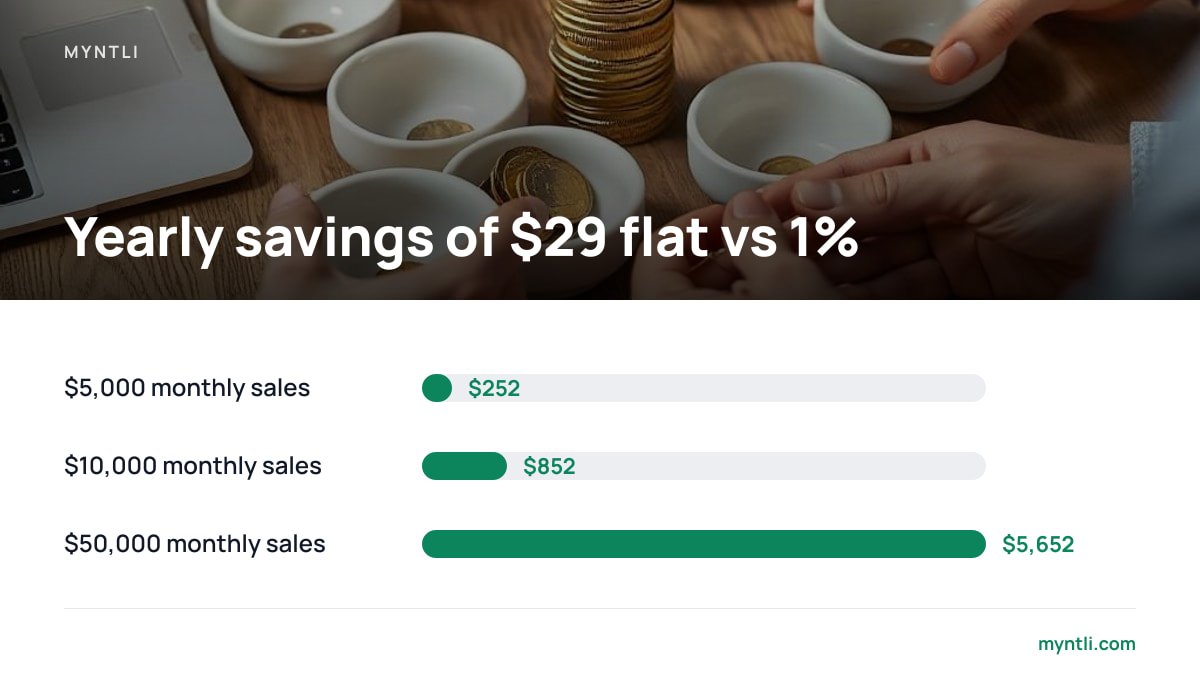
| $5,000 | $50 | $150 | $29 | $252 |
| $10,000 | $100 | $300 | $29 | $852 |
| $50,000 | $500 | $1,500 | $29 | $5,652 |
At a 1% fee, $2,900 a month in bitcoin sales is the breakeven point. Above that, every dollar you sell costs you more under a percentage than under a flat $29.
The table also leaves out the conversion spread and payout fees from the previous section. Add those to the percentage column and the breakeven point drops further. For a closer look at this calculation, including what happens when your volume is seasonal, see our breakdown of flat monthly fee bitcoin payments.
Below roughly $2,000 a month, a percentage processor can cost less in dollar terms. In that range you are mostly paying for convenience. The case for switching then depends on custody, which the next sections cover.
What You Still Pay When the Percentage Goes to Zero

Removing the processor's cut does not make bitcoin payments free. It is better to know the remaining costs before you switch than to find them on your first busy weekend.
- Network fees. Every on-chain payment pays a miner fee set by demand for block space. The customer usually pays it at checkout. You pay it again when you move or consolidate funds later.
- Consolidation costs. Many small payments leave your wallet holding many small coins, called UTXOs. Spending them all later takes a larger transaction, and that transaction costs more in fees.
- Hosting. A payment server has to stay online, stay synced and stay updated. Either you run it or you pay someone to.
- Your own time with the wallet. You hold your own keys. Backups, seed phrase storage and deciding when to sell bitcoin are now your responsibility.
The free, open-source BTCPay Server project charges no processing fee at all. Its software cost is zero, so the costs in the list above are the whole bill. BTCPay also supports the Lightning Network, which moves small payments off-chain where fees are usually a fraction of a cent. That makes it worth switching on if you sell low-priced items.
Pro Tip: Consolidate your small UTXOs when the mempool is quiet, which is often on weekends. Combining dozens of small payments into one coin during a low-fee period can cost a fraction of the same transaction on a busy weekday. In BTCPay's store settings, set the extra network fee to apply only when a customer pays an invoice in more than one transaction. Customers who pay in a single transaction then pay no surcharge, while split payments still cover the cost of the extra coins they create.
Custody: The Cost That Never Appears on an Invoice

A percentage-based processor usually holds your money between the customer's payment and your payout. That period carries risk. The processor can freeze your account, delay a withdrawal, change its terms, or stop serving your country or product category. None of those risks appear on your fee statement.
A non-custodial setup works differently. The customer pays directly into a wallet that only you control. There is no balance waiting to be released and no account that can be frozen for review. Your store is not the payment provider's customer, so no one runs identity checks on it.
The trade-off is real. When you control the keys, there is no support desk to recover lost funds. If you lose your seed phrase, the funds are gone. Our guide to custodial vs non-custodial crypto payment processors covers this in detail. In short: if you can store a seed phrase safely, custody is worth taking back.
Under a custodial processor, the percentage fee pays for the processor to hold your money. Under a non-custodial setup, the money never leaves your wallet.
Which Model We'd Pick, by Store Size
There is no single right answer for every store, but at each sales volume one option stands out.
- Under $1,000 a month in bitcoin. If you need dollars in your bank account and have no interest in holding bitcoin, a percentage processor is fine. If you would hold bitcoin anyway, a flat host still makes sense because it lets you take custody now.
- $1,000 to $3,000 a month. The costs are close to even. Choose based on custody rather than price. We would choose non-custodial.
- $3,000 to $20,000 a month. A flat monthly host is clearly the better choice. At $10,000 a month, the savings over a 1% fee come to about $850 a year, before counting spreads and payout fees.
- Above $20,000 a month, or if you need full control. Run a node on your own server. A one-time setup cost plus your own server bill comes out well ahead of thousands of dollars a year in percentage fees, and no third party sits in your payment path.
If you are still choosing between a hosted store and your own node, our BTCPay Server installation service guide compares the two side by side.
Stop Paying a Cut on Every Bitcoin Sale for $29 a Month
Myntli runs BTCPay Server for you. You pay a flat $29 a month for a hosted store on our node, or a one-time $449 for a full node installed on your own server. We take no percentage from your sales. Customers pay straight into your own wallet. We do not hold your funds, and we do not run identity checks on your store.
We connect BTCPay Server to WooCommerce, Shopify, Ghost, Magento, PrestaShop, Drupal Commerce, Invoice Ninja or ReplaPay. We handle node monitoring, updates and sync, and we can help you set up a wallet if you do not have one yet. API access is available if you need a custom integration.
One honest limit: Myntli does not convert your bitcoin to dollars. If you need fiat in your bank account, you will sell through an exchange, which charges its own fees. Check that cost before you compare it against a processor's all-in rate.
Frequently Asked Questions
What percentage fees do bitcoin payment processors usually charge?
Many custodial bitcoin processors charge around 1% per transaction. That rate often leaves out conversion spreads and payout fees, so the true cost can be noticeably higher. Ask for a worked example that shows the exact amount a $1,000 sale becomes in your account.
At what sales volume does a flat monthly fee beat a percentage fee?
Against a 1% fee, a flat $29 monthly host breaks even at $2,900 a month in bitcoin sales. Above that point, the flat fee is cheaper and the gap grows with every sale. Once you include spreads and payout fees, the breakeven point is lower still.
Are bitcoin payments free if there's no percentage fee?
No. Every on-chain transaction pays a network fee to miners, and you pay again when you consolidate small payments in your wallet. Lightning payments cut this to fractions of a cent, but you still need hosting and must manage your own keys.
Why do bitcoin processors charge a percentage when there are no chargebacks?
Confirmed bitcoin transactions cannot be reversed, so the processor carries no chargeback or credit risk. The percentage mostly pays for custody and conversion to fiat. If you do not need those services, a non-custodial setup removes the fee.
Does BTCPay Server charge a transaction fee?
No. BTCPay Server is free, open-source software and takes no cut of your payments. Your costs are hosting, bitcoin network fees, and either your own time running the server or a managed host's monthly fee.
Sources
- Regulation II (Debit Card Interchange Fees and Routing) | Board of Governors of the Federal Reserve System
- Bitcoin: A Peer-to-Peer Electronic Cash System | Bitcoin.org
- BTCPay Server: Free, Open-Source Bitcoin Payment Processor | BTCPay Server Foundation
- BTCPay Server Documentation | BTCPay Server
- Lightning Network | Lightning Network